
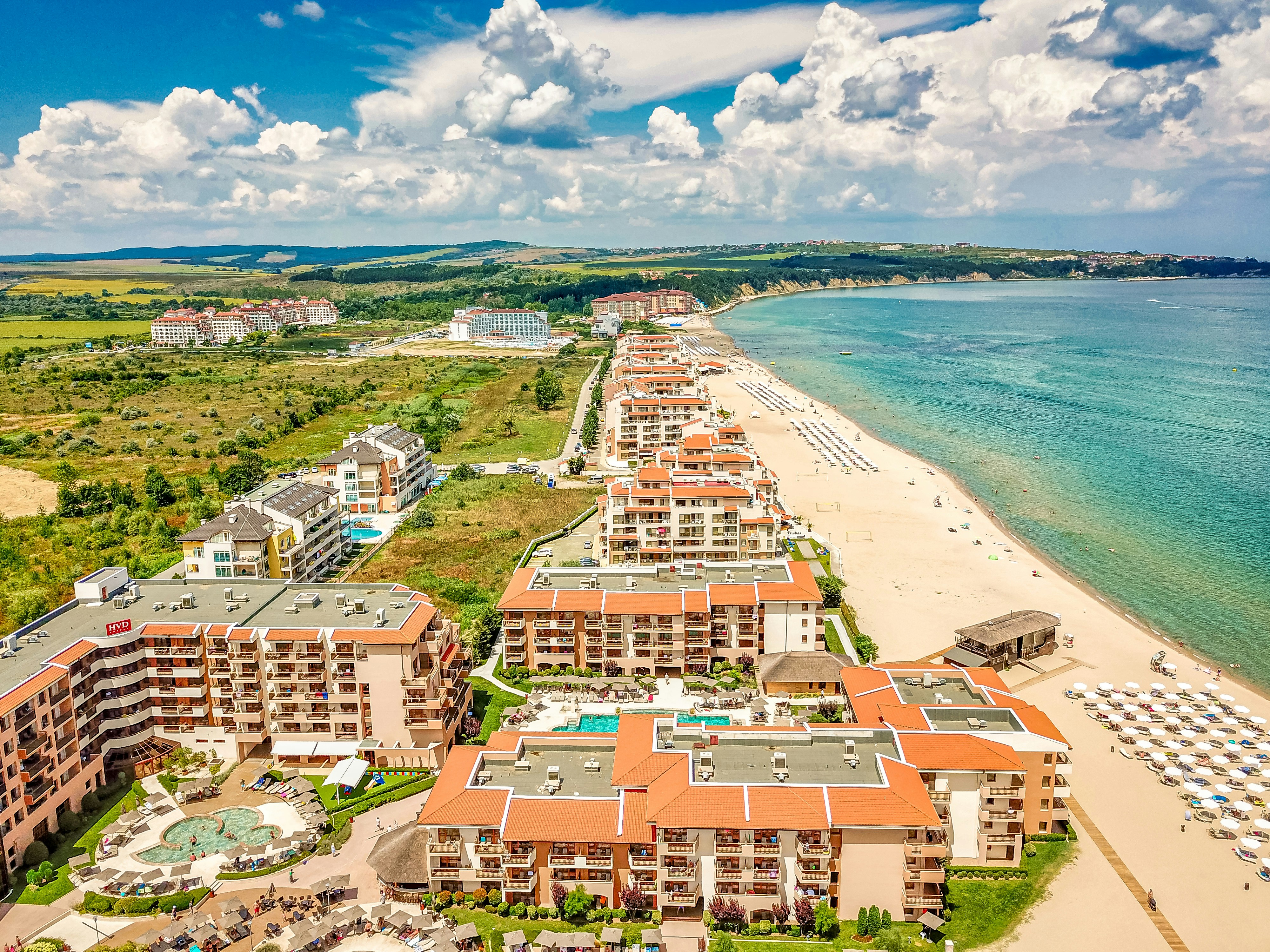
Investment Thesis · Bulgaria
Europe's Most Compelling Real Estate Opportunity.
Bulgaria offers international investors a rare combination: EU-protected ownership, sub-€2,000/m² entry prices in Varna, historically strong rental yields, and a 10% flat tax rate. A market that Western capital is increasingly discovering.
This page presents the complete investment thesis for Bulgarian real estate, covering market fundamentals, tax structure, comparative analysis against peer European markets, and the structural drivers of long-term value growth.
“Bulgaria is where Portugal was in the early 2000s, before the rest of Europe noticed.”
Structural Market Drivers
Why Bulgaria. Why Now.
Six structural factors that make Bulgaria one of Europe's most compelling real estate investment markets for international capital.
EU Membership & Legal Framework
Bulgaria joined the European Union in 2007, granting foreign nationals the same property rights as Bulgarian citizens. All transactions are governed by EU law, the same framework protecting property ownership in France, Germany, and Spain. Title registration is transparent, legally binding, and enforceable across the EU.
Tourism Growth & Rental Demand
Bulgaria receives over 10 million tourists annually, with the Black Sea coast, particularly Varna, Sunny Beach, and Sozopol, driving peak-season short-term rental demand. The growing digital nomad community and expanding expat population provide year-round rental income stability beyond the tourist season.
High Profit Resale Market
Prime coastal and city-centre properties in Varna and Sofia have shown 10–15% annual resale appreciation, driven by strong domestic and foreign migration, foreign investment inflows, and constrained supply in premium locations. Varna in particular is recognised as a high profit resale market with strong demand from both local and international buyers.
Currency Stability & Eurozone
The Bulgarian Lev maintained a fixed peg to the Euro since 1997, providing decades of monetary stability with zero exchange risk. Bulgaria adopted the Euro in 2026, joining the Eurozone and eliminating all currency risk for Euro-denominated investors. This historic milestone provides the highest level of monetary stability and further strengthens investor confidence.
Strong Domestic & Foreign Migration
Bulgaria is experiencing strong domestic migration toward Varna and Sofia, combined with growing foreign migration from Western Europe and beyond. Bulgaria's low cost of living, approximately 40% below the EU average, combined with Schengen Area membership and high-speed internet infrastructure, is attracting a new wave of remote workers, retirees, and expats driving year-round residential rental demand.
Low Entry Price, High Upside
At €1,500–2,000/m² in prime Varna locations, Bulgarian property is priced at a fraction of comparable EU coastal markets: Alicante (€2,800/m²), Lisbon (€4,200/m²), or Nice (€6,500/m²). The convergence trade, as Bulgaria approaches Western European income levels, represents a structural long-term appreciation driver.
Tax Efficiency
The Tax Advantage That Changes the Math
Bulgaria's 10% flat tax rate is not a loophole. It is the law. The same rate that applies to Bulgarian citizens applies to international investors.
10% Flat Income Tax
Bulgaria operates one of Europe's lowest and simplest tax regimes. All personal income, including rental income, is taxed at a flat 10% rate. No progressive brackets, no complexity.
10% Corporate Tax
Investors who hold Bulgarian property through a Bulgarian company benefit from a flat 10% corporate tax rate, one of the lowest in the EU. Dividends are taxed at an additional 5%.
No Wealth Tax
Bulgaria does not levy a wealth tax or annual net worth tax on property holdings. Your capital appreciation is not taxed until realisation.
Low Property Transfer Tax
Property acquisition costs in Bulgaria are among the lowest in the EU, approximately 3–5% total (notary fees, transfer tax, registration). No stamp duty equivalent.
Double Tax Treaties
Bulgaria has signed double taxation agreements with over 70 countries, including the UK, Netherlands, Germany, France, and the USA, preventing investors from being taxed twice on the same income.
VAT Reclaim on New Builds
Investors purchasing new-build properties through a Bulgarian company can reclaim the 20% VAT on the acquisition price, significantly reducing the effective entry cost.
Ownership Structures
How International Investors Structure Their Bulgarian Portfolio
Direct Personal Ownership
Simplest structure. Property held in your personal name. Rental income taxed at 10% flat rate. Suitable for single-asset investors.
Bulgarian EOOD (LLC)
Single-member limited liability company. 10% corporate tax, 5% dividend withholding. Optimal for multi-asset portfolios and VAT reclaim on new builds.
Bulgarian OOD (Partnership)
Multi-member structure for joint investment vehicles. Flexible profit distribution, same 10% corporate tax. Suitable for co-investment arrangements.
Tax information is provided for general guidance only. Dual Lion Capital recommends consulting a licensed Bulgarian tax advisor for personalised structuring advice. Tax laws are subject to change.
Comparative Analysis
Varna vs. European & Mediterranean Markets
Average residential property prices per m² across key coastal and prime European destinations.
The Convergence Thesis
At €2,000/m², Varna offers the lowest entry price among all comparable coastal and prime European markets. As Bulgaria's GDP per capita converges toward the EU average, driven by EU cohesion funding, wage growth, and Eurozone accession, property prices will follow. Investors entering today are positioned to benefit from the same convergence trade that drove 300–500% appreciation in Spain, Portugal, and Poland over the past two decades.
Data sourced from Numbeo, local real estate portals, and market reports. Figures represent approximate market averages as of 2026.
Investor Questions
Frequently Asked Questions
Answers to the questions every serious investor asks before committing capital to a new market.
Yes. EU citizens can own property in Bulgaria on the same terms as Bulgarian nationals. Non-EU citizens can own buildings and apartments freely; land ownership by non-EU nationals requires a Bulgarian company structure. All ownership is registered in the Bulgarian Property Register and protected under EU law.
Your Capital. Professionally Managed.
We work with a select group of international investors, ensuring every client receives the deal access, legal structuring, and portfolio oversight that serious capital deserves. Our model is built on long-term partnership, not transaction volume.
Our approach: Full transparency on fees, timelines, and investment rationale, before you commit to anything.
Speak With Our Team